Prologue
"AKTE STUTTGART" is built for lovers and haters of the Brustring. History becomes legend, legend becomes myth. And myth becomes cult — or cause for eternal cringe, depending on the season.
5 league titles! 73 points as runners-up! DFB-Pokal winners 2025! And in between: relegations, play-off nights, boardroom wars that grow larger than the last match. VfB is the club of wild swings — from the championship years 1950/52 through the Daum title in 1992 to the Veh Spring of 2007. The "Junge Wilden" turned youth into a movement, 1998 took them to a European final in Stockholm, and 2025 brought a real trophy moment back to Berlin: DFB-Pokal, number four.
Akte Stuttgart comes in three parts: The Club Dossier tells the story in 12 chapters. Match Intelligence delivers live data. And Predictions tie it all together — with prediction markets, systematic trading and smart-money logic. No betting, no gambling — event trading with risk management.
Akte Stuttgart is part of Akte Bundesliga — the same concept for all 18 Bundesliga clubs.
Fact Sheet
Verein für Bewegungsspiele Stuttgart 1893 e.V. — known as VfB Stuttgart — counts roughly 126,000 members, making it one of Germany's largest sports clubs and by far the biggest in Baden-Württemberg.
Founded September 9, 1893 as FV Stuttgart 1893. Merged with Kronen-Klub Cannstatt on April 2, 1912 to form VfB Stuttgart 1893 e.V.
Founding member of the Bundesliga (1963). Currently 5th in the all-time Bundesliga table. Honours: 5 German Championships (1950, 1952, 1984, 1992, 2007) and 4 DFB-Pokal titles (1954, 1958, 1997, 2025).
Home ground: MHPArena Stuttgart in NeckarPark (Bad Cannstatt). 60,058 capacity (Bundesliga), 54,272 seats (international). 64 boxes, 3,500 business seats — Stuttgart can do terrace atmosphere and corporate hospitality.
Good to Know
Rugby before round-ball romance. VfB's roots lie in predecessor club FV Stuttgart 1893 — which was rugby-driven. So seriously that Stuttgart reached the 1909 German rugby championship final (and narrowly lost). A parallel universe.
The Brustring wasn't invented by marketing. The iconic red chest stripe was first worn in 1925 — in a friendly against Alemannia Worms. Less fashion, more identity statement.
1975: The first real fall — despite the goals. Stuttgart's first-ever Bundesliga relegation in 1975. Mid-crisis, Albert Sing took over — a coach who reportedly had players sing folk songs. Not a joke. Even Hermann Ohlicher, 17 goals in 34 games, couldn't prevent the drop. Peak VfB: drama not from lack of quality, but from the club's inability to build solid ground from strong individual performances.
For the Haters
As a VfB hater, you don't need to dig deep — the stats deliver ammunition regularly. Stuttgart has multiple "crash" eras:
Worst finish: 17th in 2015/16 (33 points, 50:75 goals) — direct relegation.
Most goals conceded: Also 2015/16 — 75 goals against.
Worst away defeat: 1-7 at Borussia Dortmund (March 14, 1964).
Most defeats: 20 losses in 2018/19 — 16th place, play-off, relegated against Union Berlin.
Fewest points: 28 in 2018/19 — the kind of season where even optimism feels like self-deception.
The real luxury for VfB haters: you don't need to exaggerate. Stuttgart took care of it themselves — in numbers that read like a warning.
For the Lovers
The golden 50s: two titles, two cups. Stuttgart become German Champions in 1950, winning the national play-off 2-1 against Kickers Offenbach. Two years later: a second title, 3-2 against 1. FC Saarbrücken. Plus DFB-Pokal 1954 (1-0 aet vs Köln) and 1958 (4-3 aet vs Düsseldorf) — four major trophies in under a decade.
Sundermann and the "Hundred-Goal Attack": 1977 back to the Bundesliga. After relegation in 1975, Jürgen Sundermann arrives — and turns everything around. With Hansi Müller and a forward line producing goals on a conveyor belt, Stuttgart march straight back up. Proof that VfB can do crisis — but also raw power.
Photo-finish champions: 1984 — decided in Bremen. The title race is settled on the penultimate matchday in Bremen — Hermann Ohlicher scores a late winner for 2-1, and suddenly the Schale is within reach.
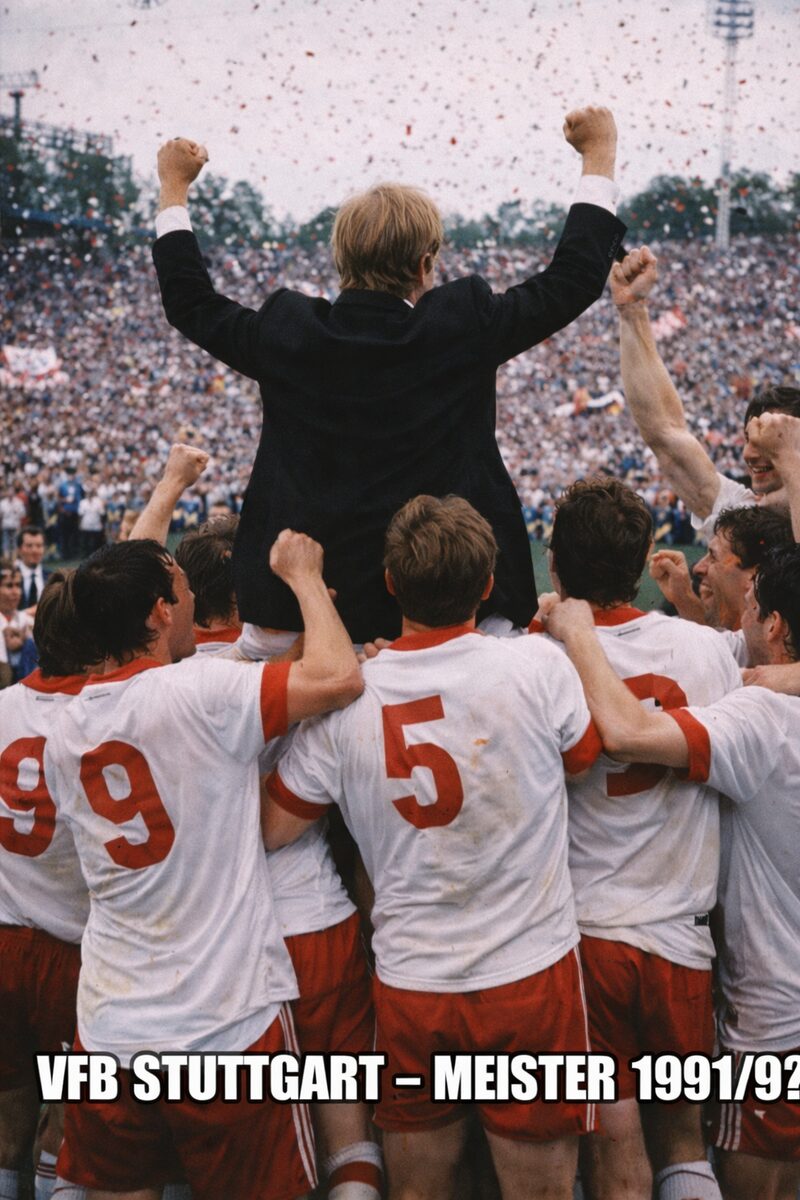
Daum 1992: Championship in a three-way fight. Stuttgart win 2-1 at Bayer Leverkusen (from behind) while the competition stumbles — and VfB are champions.
European nights. UEFA Cup Final 1989 against Napoli and Maradona (first leg 1-2, second leg 3-3 — aggregate 4-5, agonizingly close). And the Cup Winners' Cup Final 1998 in Stockholm: 0-1 against Chelsea.
DFB-Pokal 1997: Elber's farewell masterclass. June 14, 1997, Berlin: 2-0 against Energie Cottbus. Giovane Elber scores both — in his final game for Stuttgart before joining Bayern. Header for the opener, chip for the clincher. Then he beats his chest with both hands: I'm still here. And now I'm leaving. For lovers, the purest form of joy.
The Veh Spring 2007. May 19, 2007, final matchday: 2-1 against Energie Cottbus — champions. With courage, pace and a young core, suddenly no longer a "project" but a champion.
The "Junge Wilden" and Manchester United. In the early 2000s, financial pressure forces VfB to rely on their youth academy. What starts as necessity becomes sensation: Hildebrand, Kurányi, Hinkel, Hleb — the "Junge Wilden" finish runners-up in 2003 and reach the Champions League. On October 1, 2003 Stuttgart beat Manchester United 2-1. Youth becomes world stage.
73 points: Runners-up 2023/24. 23 wins, 78:39 goals — a season that felt like the return of self-respect.
DFB-Pokal 2025: Title number four. Stuttgart win the final 4-2 against Arminia Bielefeld — Woltemade, Millot (×2), Undav score inside 28 minutes. The first trophy in 18 years.
Most Important Persons
Robert Schlienz — The Unbreakable. Lost his left arm in a car accident in 1948. Came back — not as a mascot, but as a key player. Led VfB through championship and cup runs in the golden 50s. Pride, pain, defiance — and always getting back up.
Guido Buchwald — The Captain with World-Class Pedigree. Reliable, tough, loyal — and internationally recognized. Led Stuttgart to the 1992 title as captain. World Cup winner 1990 (famous for his marking job on Maradona). He brought an aura rare in Cannstatt: the self-assurance that Stuttgart belong at the very top.
Giovane Elber — The Farewell King. The tip of the "Magic Triangle" with Bobic and Balakov — a forward line that terrorized Europe. His final VfB game was also his greatest: 1997 cup final, a brace, chest-beating — then off to Munich. Farewell as triumph.
Joachim "Jogi" Löw — The Coach Before He Became "The National Coach." In Stuttgart, Löw forges talent and audacity into a title-contending side. DFB-Pokal 1997, European final 1998 — proof that VfB can be modern, fast and bold.
Christoph Daum — The High-Voltage Title Winner. Maximum energy, maximum ambition, maximum friction. Under him, VfB become 1992 champions — in a finish that felt like a wild sprint. Success doesn't come quietly here.
Armin Veh — The Veh Spring. Takes over a young squad — and suddenly "potential" becomes a title. Champions 2007. You don't always need the biggest names to achieve greatness — but you need to set the right people free at the right moment.
Gerhard Mayer-Vorfelder — The Power Broker. Shaped the club for decades as president — with political instinct, a firm hand and the will to position Stuttgart as a major club. Architect and anchor for some, symbol of a "push-through" rather than "talk-it-out" era for others.
Personae Non Gratae
Kevin Großkreutz — The Crash-Landing of Hope. When the World Cup winner arrived in Stuttgart, it sounded like "exactly the guy to pull us out." In March 2017, his contract was terminated by mutual consent — officially after "incidents" handled internally. Big expectations, small ending.
Jos Luhukay — The Short-Term Coach. After the 2016 relegation, he was meant to bring calm, structure and promotion. Instead: existential debates on a weekly basis. Luhukay resigned in mid-September 2016, after just a few months. It never really fitted — ambition, environment and dressing room were never aligned.
Michael Reschke — The Sporting Director Who Bet Wrong. Transfers, squad logic, coaching changes — and ultimately, the naked table. Dismissed as sporting director in 2019 due to "negative sporting development."
Wolfgang Dietrich — The President Who Escalated. In July 2019, a members' assembly is abandoned after the electronic voting system fails. A day later, Dietrich resigns. Too much tension, too little trust, too much "us versus them" within the club.
Tragic
Robert Schlienz — The One-Armed Player. Lost his left forearm in a 1948 accident. Returned — not as a feel-good story, but as a performer. Became the heartbeat of the side that won back-to-back titles in 1950 and 1952. The tragedy isn't the ending — it's the price.
Silas Katompa Mvumpa — The Breakthrough Kid, Derailed by Fate. Pace, power, a season where every sprint looked like "VfB are back" — then the 2021 ACL tear. As if that weren't enough: it emerged he'd been registered under a false name and age for years — a victim, he said, of his former agent's schemes. And still: he came back.
Jordan Meyer — Gone Too Early. Ten years at the club, junior international, professional contract. Then: injuries, always the knee, cartilage damage in the end. Meyer retired — not because the will was lacking, but because the body drew the line.
Christian Gentner — The Captain at the Wrong Moment. 2017: a collision with Wolfsburg keeper Casteels leaves him with multiple facial fractures. 2018: his father dies after the home game against Hertha at the stadium. Stories that suddenly make football feel small.
OMG — Oh My God
Lost in Regulation — how Stuttgart eliminated themselves from Europe. 1992/93 against Leeds United: won the first leg 3-0. In the second leg, four "foreign players" were suddenly on the pitch — UEFA allowed a maximum of three. The match was awarded 3-0 to Leeds, a decider followed (1-2 loss), and Stuttgart were out. Not because of football. Because of a rule they spotted a tick too late in Cannstatt.
Voting system down — Members' assembly as tech drama. July 14, 2019: assembly abandoned because the electronic voting system crashed. The club called it "inexcusable." A day later, president Dietrich resigned.
Banner chaos in Bochum. Fan banners blocked an emergency exit — nobody wanted to move. The talking point became safety, not football.
Animal pitch invader — cup game with bunny highlight. During a cup tie in Kiel, a hare ran across the pitch. Stuttgart advanced, but the image stuck.
Offside line from hell. After a 3-3 draw in Heidenheim, a Demirović goal was disallowed — TV images suggested the calibrated offside line may have been applied to the wrong player. Stuttgart feeling, 2026 edition.
Fun Facts
The stadium has been called (almost) everything. From Neckarstadion to Gottlieb-Daimler-Stadion to Mercedes-Benz Arena to MHP Arena (since 2023): stay a fan long enough and you collect stadium names like others collect stickers.
Fritzle is a crocodile — and he hatched from an egg. A giant egg appeared in the 1992/93 team photo — shortly after, the VfB alligator "hatched" and later became cult mascot Fritzle.
Cabbage art on the chest. The "StuttgART jersey" is officially an art object: pattern = cross-section of a Filderkraut cabbage, limited to 1,893 pieces, priced at €189.30. Local pride, collector instinct and self-irony in one shirt.
The all-time top scorer isn't Klinsmann, Gomez or Guirassy — it's Allgöwer. Karl Allgöwer: club record with 166 goals (all competitions). The kind of knowledge that earns you respect at the pub.
7-0 away. VfB's biggest Bundesliga away win: 7-0 at Fortuna Düsseldorf (1985/86).
2007 champions: top of the table only when it mattered. Stuttgart crept up late, sat top after rivals stumbled, and had everything in their own hands on the final matchday. Not "dominant start to finish" — more "got hot at exactly the right moment."
Even the mascot can predict. Ahead of the 2025 cup final, Fritzle reportedly predicted the exact 4-2 scoreline. In Cannstatt, they apparently call that tradition.
Special Moments
The "Jumbo Jet" — genius technician, too heavy, too stubborn. And with a shot that wrote history.
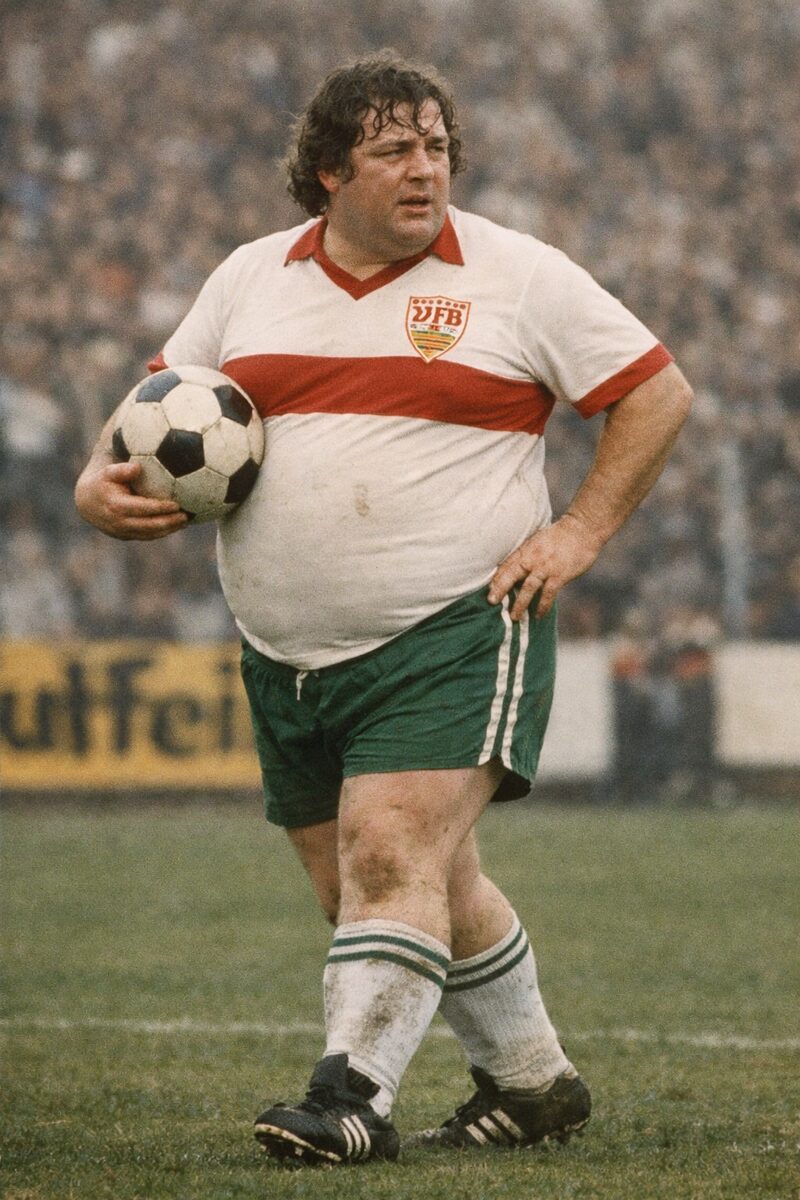
Some footballers would be impossible today. Too much personality, too little fitness plan. Johann "Buffy" Ettmayer was one of them. 97 games, 34 goals for VfB (1971–1975). A midfielder who scored like a striker.
The moment: January 26, 1974, home against Eintracht Frankfurt. Ettmayer fires — unstoppable. It's the 10,000th goal in Bundesliga history. And simultaneously goal of the month. Stuttgart win 3-1.
The best Ettmayer moment: coach Albert Sing finally picks him again after a long feud. Ettmayer promptly scores. Runs to Sing and asks: "Does the goal count?" Sing: Why wouldn't it? Ettmayer grins: Because he scored it — "the fat one." Self-irony as a weapon.
Elber's last dance — Cup Final 1997.
June 14, 1997, Berlin's Olympic Stadium. Elber knows: it's his last game for VfB. Header for the opener (18'), chip for the clincher (52'). Then the image that remains: after the second goal, he beats his chest with both hands. No jersey swap, no farewell letter — just a man showing: I'm still here. And now I'm leaving.
Words of Wisdom
"I'm Swabian through and through, and when I hear the word 'Heimat,' I immediately think of Stuttgart."
— Jürgen Klinsmann"Giovane was the samba dancer, Krassimir was the conductor."
— Fredi Bobic on the Magic Triangle"We didn't need to talk much. We'd glance at each other and everyone knew what the other was going to do."
— Giovane Elber on Bobic and Balakov"If anyone here doesn't believe we're going up this year, they can leave the room right now."
— Jürgen Sundermann (1977, before the promotion)"I'm not a track athlete, I'm a footballer."
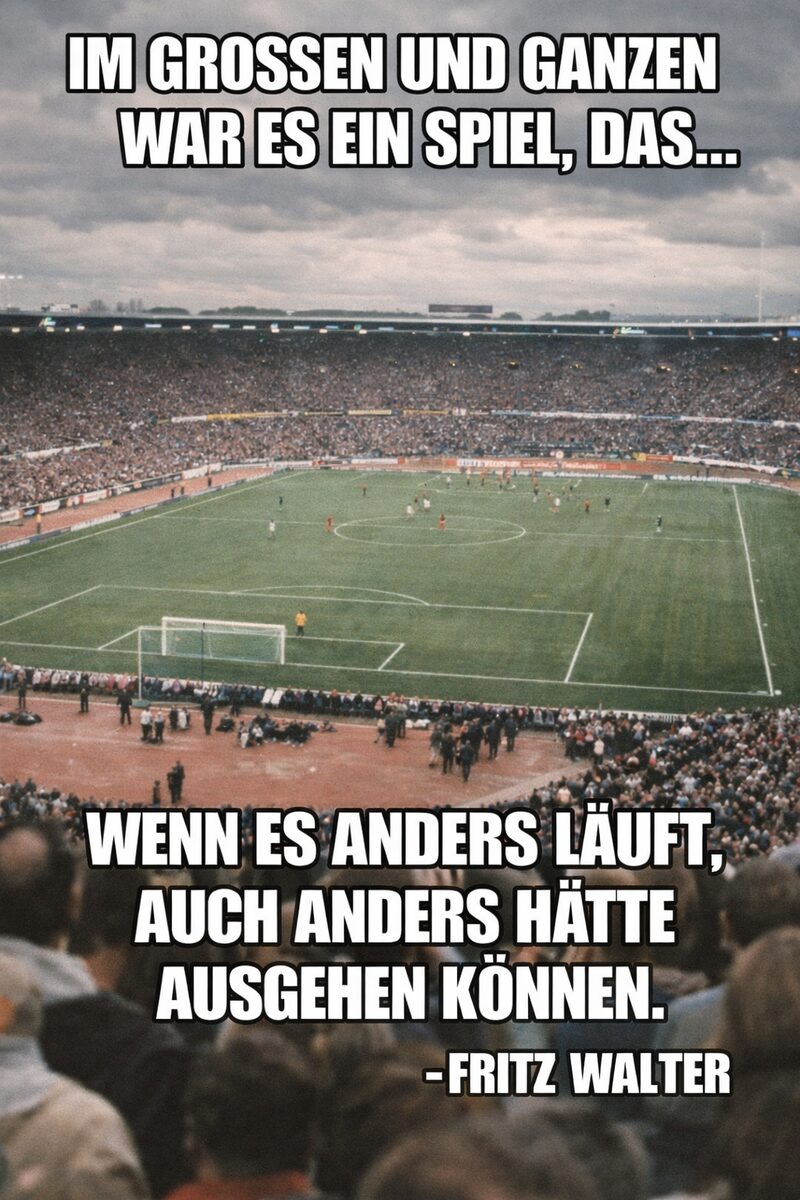
— Johann "Buffy" Ettmayer"All in all, it was a game that, had it gone differently, could also have ended differently."
— Eike Immel"Jürgen Klinsmann and I, we make a good trio. I meant: a quartet."
— Fritz Walter Jr."In summary, I have clearly come to the conclusion that we were absolutely deserved German champions."
— Armin Veh (2007)"For me, VfB always stood above all personal ambitions. My football heart belongs to the VfB."
— Hermann Ohlicher"VfB is my Heimat — but it also shows that you can suffer because of your Heimat."
— Winfried KretschmannPredictions · Coming Soon
Oracle forecasts, season markets and value signals — coming soon.